
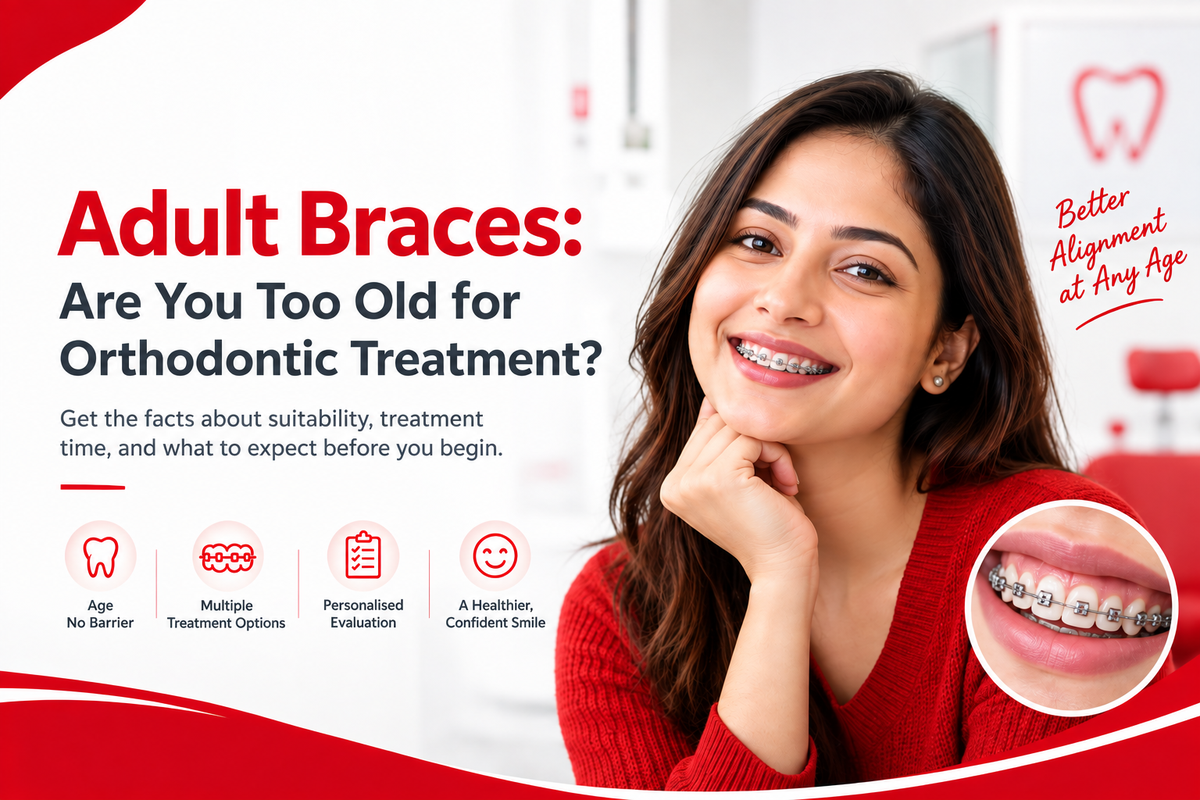
Thinking about braces as an adult? You may be wondering whether you are too old for orthodontic treatment.
The good news is that age alone does not automatically rule out braces. Adults in their 20s, 30s, 40s, and beyond may be suitable for orthodontic treatment. What matters more is the condition of your teeth, gums, supporting bone, bite, and the specific problem that needs to be corrected.
If you are considering adult braces in Hyderabad, an orthodontic evaluation can help determine whether braces or another treatment option is appropriate for your individual needs.
Can Adults Get Braces?
Yes. Adults can undergo orthodontic treatment when their teeth, gums, and supporting structures are suitable for treatment.
Adults may consider braces for problems such as:
- Crowded or overlapping teeth
- Gaps between teeth
- Crooked or rotated teeth
- Certain bite problems
- Teeth that have shifted over time
- Alignment problems that make cleaning more difficult
Before treatment begins, your dentist or orthodontist will evaluate your oral health and tooth position to understand the cause of the problem and determine the appropriate treatment approach.
Is There an Age Limit for Braces?
There is no single age at which braces automatically become unsuitable.
Someone in their 20s may want to correct teeth that have been misaligned since childhood. A person in their 30s or 40s may seek treatment because their teeth have shifted over time. Older adults may also be considered for orthodontic treatment when their oral health and supporting structures are suitable.
The more useful question is not simply “Am I too old for braces?” but “Are my teeth and gums healthy enough for orthodontic treatment, and what needs to be corrected?”
Why Do Adults Choose Braces?
Adults may seek orthodontic treatment for both functional and appearance-related reasons.
Crowded Teeth
When teeth overlap or are positioned too closely together, cleaning between them can be more difficult. Orthodontic treatment may help improve tooth alignment and make certain areas easier to maintain.
Gaps Between Teeth
Spaces between teeth can develop for different reasons. Depending on the cause and the overall dental condition, orthodontic treatment may be used to move teeth into a more suitable position.
Bite Problems
A bite problem occurs when the upper and lower teeth do not meet in an ideal relationship. Some bite problems can affect chewing or place uneven forces on the teeth.
An orthodontic evaluation can determine whether bite correction is required and what treatment options may be appropriate.
Teeth That Have Shifted
Teeth can move over time. This can happen naturally with age or when previous orthodontic treatment was not maintained with appropriate retention.
If your teeth have become crowded or developed new spaces after earlier treatment, an orthodontic assessment can help determine the reason for the change.
What Should Be Checked Before Adult Braces?
Adult orthodontic treatment involves more than simply looking at whether teeth are crooked.
Before starting treatment, your dentist or orthodontist may assess:
- Gum health
- Tooth decay
- Existing fillings, crowns, or other dental restorations
- Missing teeth
- Tooth position and spacing
- Bite relationship
- Oral hygiene
- Supporting bone and overall dental condition
If active tooth decay or gum disease is present, it may need to be treated before orthodontic treatment begins.
Adults may also have existing dental work or missing teeth that can affect treatment planning. This is why an individual examination is important before deciding which type of orthodontic treatment is suitable.
What Happens During an Adult Braces Consultation?
An adult orthodontic consultation usually begins with an examination of your teeth and bite.
Depending on your situation, your dentist or orthodontist may:
- Examine tooth alignment and spacing
- Check how your upper and lower teeth meet
- Assess your gums and oral hygiene
- Look for cavities or other dental problems
- Review existing fillings, crowns, or missing teeth
- Take dental photographs or X-rays when needed
- Discuss suitable treatment options
- Explain the expected treatment process and retention requirements
The purpose of this evaluation is not simply to determine whether you can wear braces. It is to understand what needs to be corrected and how the treatment should be planned for your particular dental condition.
How Do Adult Braces Work?
Braces use brackets and orthodontic wires to apply controlled forces to the teeth. These forces gradually guide the teeth toward planned positions.
Treatment takes place over time rather than through a single adjustment. Regular appointments allow the orthodontic provider to monitor tooth movement and make necessary adjustments.
The exact treatment approach depends on the alignment problem, bite, tooth position, oral health, and overall treatment goals.
How Long Do Adult Braces Take?
There is no single treatment duration that applies to every adult.
Treatment time can vary depending on:
- The amount of tooth movement required
- The complexity of the bite problem
- Tooth and gum health
- The type of orthodontic treatment
- The response of the teeth during treatment
- How consistently appointments and oral-care instructions are followed
Your orthodontic provider can give you a more meaningful estimate after examining your teeth and developing an individual treatment plan.
Are Adult Braces More Difficult Than Braces for Teenagers?
Adult orthodontic treatment can involve additional considerations because adults may have fillings, crowns, missing teeth, gum problems, worn teeth, or other existing dental conditions.
This does not automatically prevent successful orthodontic treatment. Instead, these factors need to be considered when planning tooth movement and deciding which treatment approach is appropriate.
For this reason, adult orthodontic treatment should begin with a proper dental and orthodontic assessment rather than choosing braces based only on age.
What Is It Like to Wear Braces as an Adult?
One of the main adjustments is getting used to having braces as part of your daily routine.
You may need to:
- Spend more time cleaning around brackets and wires
- Be careful with hard or sticky foods
- Attend scheduled orthodontic appointments
- Follow oral-hygiene and appliance-care instructions
- Allow your mouth time to adjust after appointments
Good oral hygiene is especially important during orthodontic treatment because plaque and food particles can collect around brackets and wires.
Adult Braces vs Clear Aligners
Adults may have several orthodontic treatment options, depending on their dental condition.
Traditional Braces
Traditional braces use brackets and wires that remain attached to the teeth during treatment. They can be used for many types of tooth movement and bite correction.
Clear Aligners
Clear aligners use a series of removable trays that gradually move the teeth. They can be an option for certain alignment problems, but they are not automatically suitable for every patient.
Clear aligners also require consistent wear and appropriate care.
The choice between adult braces and clear aligners depends on factors such as:
- The type and complexity of tooth movement required
- Bite relationship
- Oral health
- Treatment goals
- Ability to follow appliance instructions
An orthodontic assessment can help determine which option is appropriate for your case.
Can Adults Get Braces If They Have Crowns, Fillings, or Missing Teeth?
Having previous dental treatment does not automatically mean that orthodontic treatment is impossible.
However, fillings, crowns, missing teeth, gum conditions, and other dental concerns may affect treatment planning.
Your dentist or orthodontist will need to assess the condition of your existing teeth and restorations before deciding how orthodontic treatment should be carried out.
Is It Worth Getting Braces as an Adult?
Whether adult braces are appropriate is an individual decision based on your dental condition and treatment goals.
Factors to consider include:
- What dental problem you want to correct
- Whether the problem affects function, appearance, or both
- Your current oral health
- The expected treatment duration
- Your ability to maintain good oral hygiene
- The treatment and retention plan recommended for your case
If crooked teeth, crowding, spacing, or bite problems are affecting you, an orthodontic consultation can help you understand what can be corrected and which treatment options may be available.
Frequently Asked Questions
Is 30 too old for braces?
No. Being 30 does not automatically prevent someone from having braces. Treatment suitability depends on the condition of the teeth, gums, supporting structures, bite, and overall treatment needs.
Is 40 too old to get braces?
Age 40 alone does not rule out orthodontic treatment. Adults may be considered for braces when their teeth, gums, and supporting structures are suitable. A dental and orthodontic evaluation is needed to determine suitability.
Is 20 too late to get braces?
No. Adults in their 20s can undergo orthodontic treatment when their oral health and dental condition are suitable for treatment.
Can adults with crooked teeth get braces?
Yes. Braces may be used to correct certain types of crooked, crowded, or rotated teeth. The appropriate treatment depends on the severity and cause of the alignment problem.
Can I get braces if I have fillings or crowns?
Possibly. Existing fillings or crowns do not automatically rule out orthodontic treatment, but they should be evaluated during treatment planning.
Are braces painful for adults?
Some people may experience temporary discomfort or pressure when braces are first placed or adjusted. Your orthodontic provider can explain what to expect and how to manage normal treatment-related discomfort.
How long do adult braces take?
Treatment time varies from person to person. The complexity of tooth movement, bite correction, oral health, and treatment response can all affect the duration.
Do adults need a dental check-up before braces?
Yes. Checking for cavities, gum problems, existing dental work, and other oral-health concerns helps with appropriate treatment planning.
Are clear aligners better than braces for adults?
Neither option is automatically better for every adult. The appropriate choice depends on the alignment problem, bite, treatment goals, oral health, and the orthodontic assessment.
Take the Next Step
If you are considering adult braces in Hyderabad, the first step is a proper dental and orthodontic evaluation.
A consultation can help you understand:
- Whether orthodontic treatment is suitable for you
- What is causing the alignment or bite problem
- Whether braces or clear aligners may be appropriate
- What treatment may involve
- How long treatment may take
- What you can expect after treatment, including retention
At Kaamat Dental Clinic, RTC Cross Roads, Hyderabad, your treatment options can be discussed after evaluating your individual dental needs.
Book a consultation to discuss your teeth, bite, and orthodontic treatment options with a dental professional.